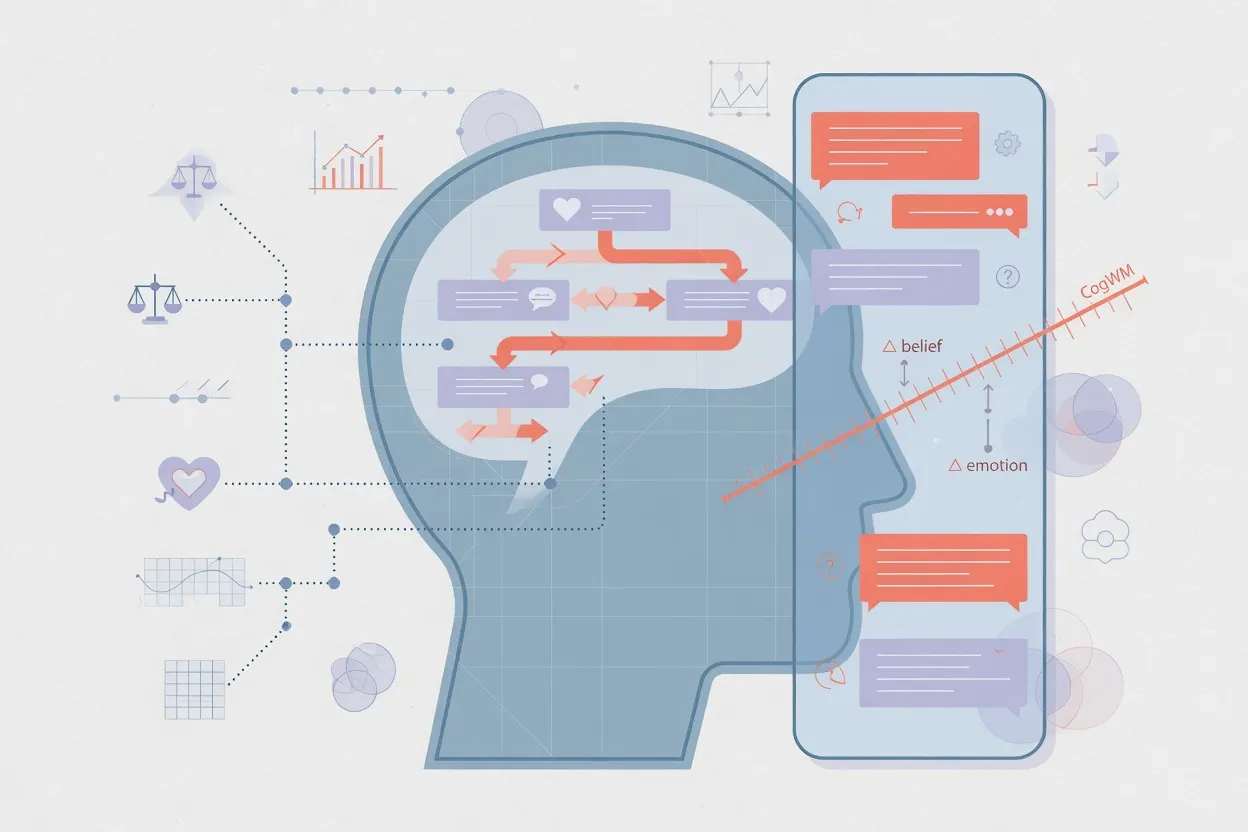
Researchers have built a tool that watches how an AI conversation rewires what you think, not just what you say.
A team published CogWM, short for Cognitive World Model, a framework trained on over 150,000 user-turn samples across four social influence scenarios. Instead of grading chatbot responses with standard text-similarity scores like BLEU or ROUGE, CogWM tracks changes in a user's beliefs, desires, intentions, and emotions across a conversation's full arc. It runs three tiers of evaluation: per-turn fidelity, trajectory-level state shifts, and a composite task score. In head-to-head testing across 3,600 multi-agent trials, it was able to distinguish six commercial AI agents by how much cognitive influence they exerted, with Meta's Llama-4-Scout ranking first on the team's composite metric.
The stakes are higher than a benchmarking paper might suggest. Existing methods score what a model says; CogWM scores what a model does to you. That distinction matters a great deal when AI systems are deployed in therapy, sales, political messaging, or any context where nudging the user is the actual goal. A model can produce grammatically tidy output while systematically shifting someone's intentions, and current metrics would never flag it.
The AI safety field has spent years worrying about what models output; this work is an early attempt to instrument what they influence. Whether regulators or labs treat it as a warning system or a leaderboard is, of course, still an open question.