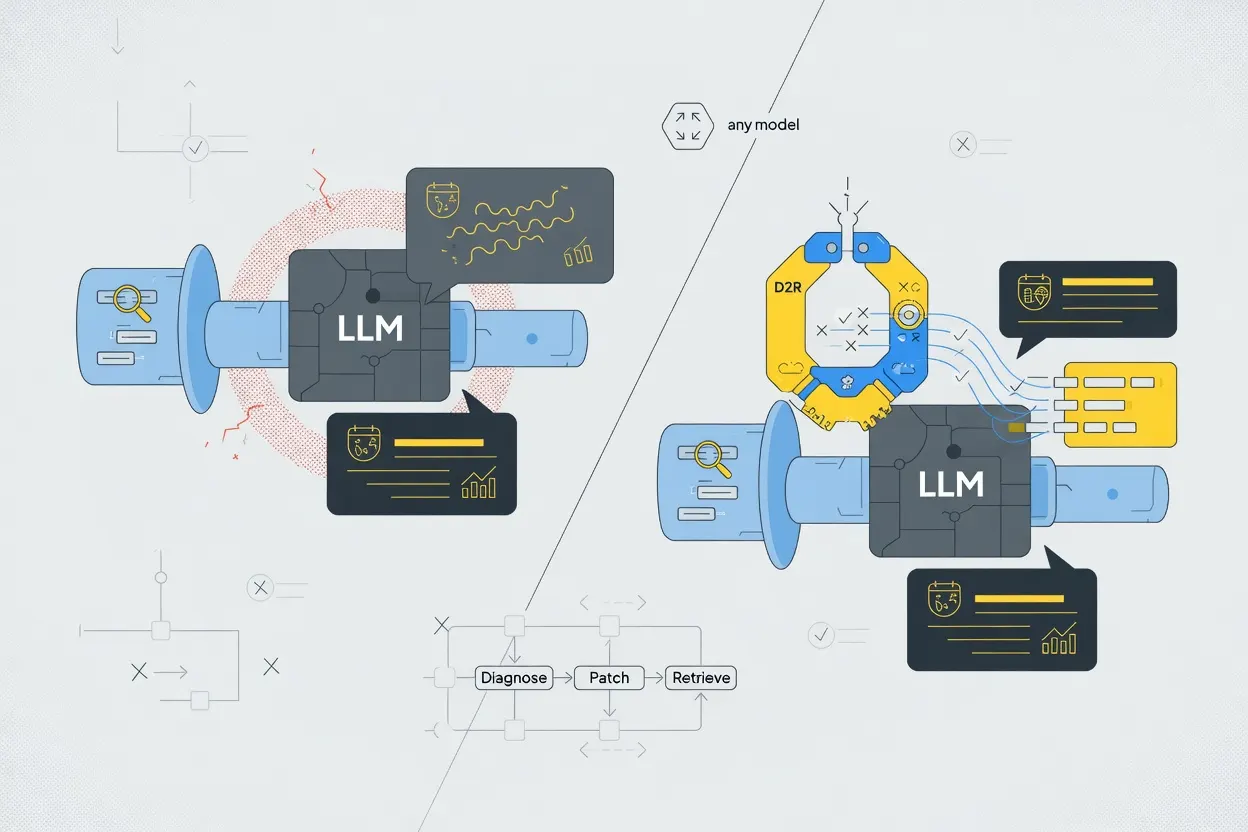
A new open-source framework targets one of the most stubborn problems in production AI: retrieval-augmented generation systems that still get facts wrong.
Retrieval-augmented generation, or RAG, was supposed to keep large language models honest by pulling in external evidence before they answer. In practice, deployments break in two predictable ways: the retrieved evidence is missing or barely relevant, or the model ignores what it retrieved and hallucinates anyway. Most fixes require either fine-tuning the underlying model or cracking it open for internal signals — options unavailable to teams running third-party APIs on a tight compute budget. The researchers behind D2R-RAG (Diagnose-to-Repair RAG) take a different approach: observe only what is already visible — the query, the retrieved chunks, and the generated response — then derive lightweight "failure signatures" that point to which corrective action to take. The system picks from a small menu of repairs within explicit latency and VRAM limits.
The budget-awareness is the part worth noting. Most academic RAG papers optimize for accuracy and treat compute as free; D2R-RAG explicitly trades off accuracy against efficiency across multiple hardware tiers, which is closer to how real engineering decisions get made. Tests on FEVER (fact verification) and HotpotQA (multi-hop reasoning) show improved reliability over recent baselines without blowing past resource constraints.
RAG error-correction is a crowded research lane right now, and benchmark wins on FEVER and HotpotQA don't guarantee the same results on messier enterprise data. Still, a model-agnostic framework with public code is more immediately useful than yet another approach that requires retraining something.