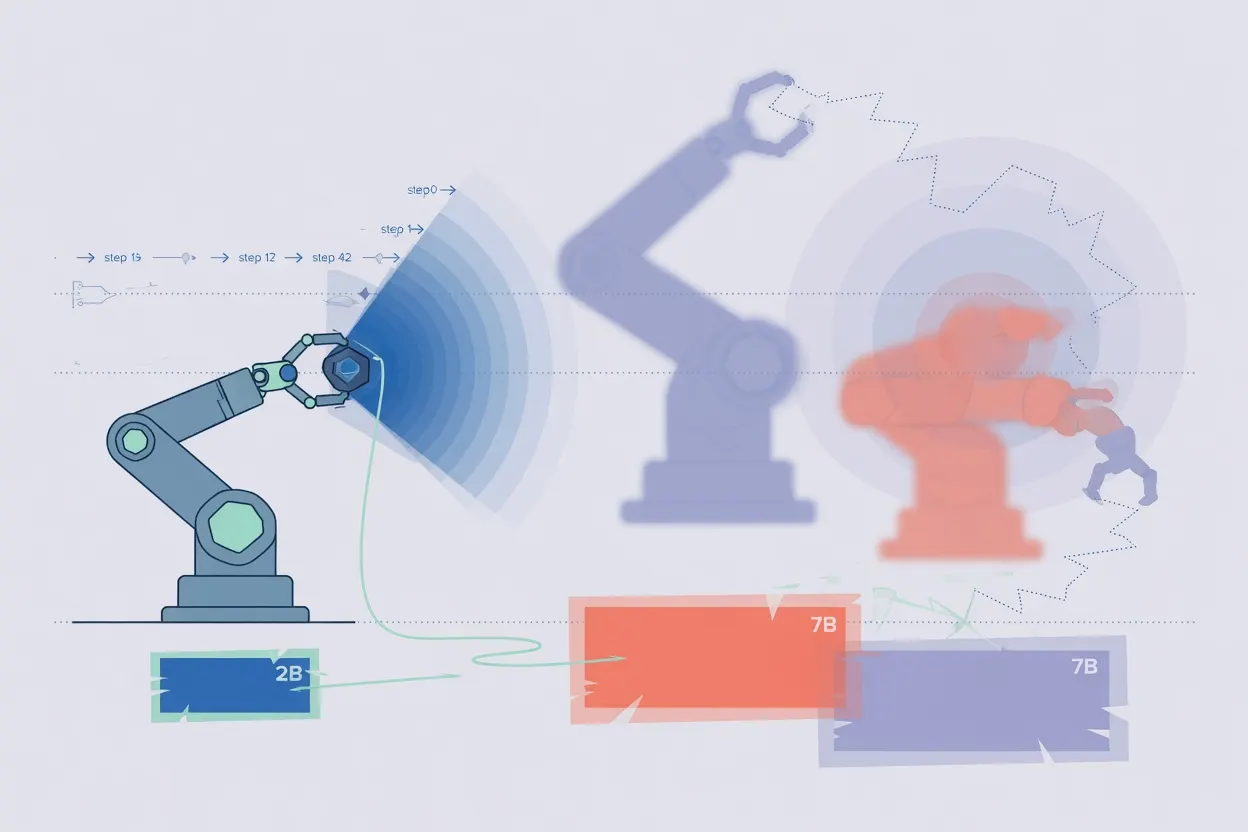
A compact robotics model beats bigger competitors by paying attention to what stage of a task it is actually in.
Researchers have released S2-VLA, a 2-billion-parameter vision-language-action model designed to handle long sequences of robotic manipulation steps without losing the plot. Most models in this space fuse visual, language, and action signals using fixed weights — meaning the model treats early and late stages of a task identically. S2-VLA swaps that in for a mechanism called State-Space Guided Adaptive Attention, which maintains a running belief state about task progression and adjusts how it weighs those three input streams accordingly. On long-horizon benchmarks LIBERO and SimplerEnv, it outperformed 7B-scale models despite being a fraction of their size.
The practical implication is that model scale is not the only lever for robotic competence. Cumulative error in long tasks — where a small misstep compounds into a failure ten steps later — has been a persistent wall for robot AI, and this work suggests that smarter feature fusion can buy more than raw parameter count. That matters for anyone deploying robots in environments where compute and power budgets are real constraints.
It is worth noting this is a preprint, not peer-reviewed, and benchmark performance on LIBERO and SimplerEnv does not always translate cleanly to physical hardware in messy real-world conditions.